Solar
Do solar panels work in winter? What a Long Island roof makes from December to February
Search "do solar panels work in winter" from Suffolk County and the top results include a UK installer's page, a portable-power brand's blog and a Reddit thread from an off-grid owner (Google results pulled November 5, 2026). They agree that panels keep working. None of them shows what a Long Island roof makes month by month, how much snow actually falls at Islip, or how PSEG Long Island's credit bank and Time-of-Day banks carry summer power into winter.
This guide does those three things. The production numbers come from PVWatts, the solar model published by the National Laboratory of the Rockies, a U.S. Department of Energy lab, run on November 5, 2026 for a point in central Suffolk near Ronkonkoma and for Hicksville in Nassau. PVWatts uses 2020 typical-year weather from the lab's National Solar Radiation Database. Snowfall comes from NOAA's 1991–2020 normals for Long Island MacArthur Airport in Islip, and the billing rules from PSEG Long Island's own pages. Every figure names its source.
These are model estimates for a standard roof, not a production promise for your house. Your own roof planes, shade and equipment decide your numbers.
The numbers, with sources
616 kWh
December output of an 8 kW south-facing array in central Suffolk, 53% of the 1,158 kWh it makes in July
PVWatts v8, run November 5, 202619%
Share of the year's 11,098 kWh that the same array makes in December, January and February
PVWatts v8, run November 5, 202654%
A west-facing roof's December output as a share of a south-facing roof's; in July the west roof makes 97%
PVWatts v8, run November 5, 202631.8 in
Normal seasonal snowfall at Long Island MacArthur Airport, Islip, 1991–2020; January is the snowiest month at 10.3 inches
NOAA NCEI U.S. Climate Normals1 kWh = 1 credit
Each extra kilowatt-hour a solar home sends to the grid in a month earns one energy credit in its PSEG Long Island bank
PSEG Long Island solar and net metering brochure~6%
Share of a south-facing array's December output made between 3 and 7 p.m., PSEG Long Island's weekday peak hours (about 27% in July)
PSEG Long Island Time-of-Day; PVWatts hourly run
Do solar panels work in winter on Long Island? The month-by-month numbers
Yes, in every month of the year. The table shows PVWatts estimates for an 8 kW array, in the six-to-ten kilowatt range PSEG Long Island calls a medium system, at a point in central Suffolk County near Ronkonkoma (40.81° N, 73.10° W). Both columns use PVWatts' standard module type, a fixed roof mount, a 30° tilt and its default 14% system losses. One roof faces due south, the other due west.
December is the low month: about 616 kWh on the south roof, 53% of July's 1,158. December through February together make about 2,126 kWh, 19% of the year's 11,098. A run for Hicksville in Nassau with the same settings gives almost the same year: 1,384 kWh per installed kilowatt against 1,387 for central Suffolk, with the same 19% share from December through February.
- Source: PVWatts v8 (NSRDB 2020 typical-year weather), 8 kW DC, standard modules, fixed roof mount, 30° tilt, 14% losses, 40.81° N 73.10° W; south = 180°, west = 270°. Run November 5, 2026.
| Month | South roof, 8 kW (kWh) | West roof, 8 kW (kWh) | South roof vs. its July |
|---|---|---|---|
| January | 649 | 382 | 56% |
| February | 861 | 575 | 74% |
| March | 974 | 739 | 84% |
| April | 1,076 | 899 | 93% |
| May | 1,061 | 1,001 | 92% |
| June | 1,061 | 1,056 | 92% |
| July | 1,158 | 1,126 | 100% |
| August | 1,086 | 959 | 94% |
| September | 970 | 771 | 84% |
| October | 885 | 601 | 76% |
| November | 702 | 411 | 61% |
| December | 616 | 333 | 53% |
| Year | 11,098 | 8,853 |
Why panels make less in winter: a lower sun, not the cold
Two things shrink winter output: fewer hours of daylight, and a sun that sits lower in the sky, so less light lands on a tilted panel. PVWatts puts the sunlight reaching that south-facing, 30° roof at 2.94 kWh per square meter per day in December, against 6.29 in July.
Cold is not the problem. The U.S. Department of Energy says PV modules operate more efficiently in colder weather, because temperatures above 77°F cause decreases in voltage. In the PVWatts hourly run, the cells on that roof average about 16°C (61°F) around noon in December and about 48°C (118°F) around noon in July. A cold, clear January day is a good day for the panels; there are just fewer daylight hours in it.
Roof direction matters more in winter than in summer
On the same model, a west-facing roof makes 97% of what a south-facing roof makes in July, but only 54% in December: 333 kWh against 616. Over the year the west roof makes 8,853 kWh, 80% of the south roof's 11,098, and only 15% of its year arrives from December through February.
If the best open roof plane on your house faces east or west, ask for each plane to be modeled on its own, by month, before you compare quotes. An annual total hides the difference.
A low winter sun also casts longer shadows. A tree or a neighbor's roof that clears your panels in June can shade them in December, so the shade check should cover winter sun angles, not only summer ones.
Snow on Long Island panels: how much falls, and whether to clear it
NOAA's 1991–2020 climate normals for Long Island MacArthur Airport in Islip give about 31.8 inches of snow in a normal season: 4.5 inches in December, 10.3 in January, 9.4 in February and 6.5 in March, with about half an inch each in November and April.
Snow on the glass stops production on the covered part of the array until it slides or melts off. The Department of Energy says most snow melts quickly off PV systems or is blown off by wind, that steeper tilts shed snow faster, with significant gains around 30 to 35 degrees, and that panels mounted in landscape shed faster and start producing again as the top third of each panel clears.
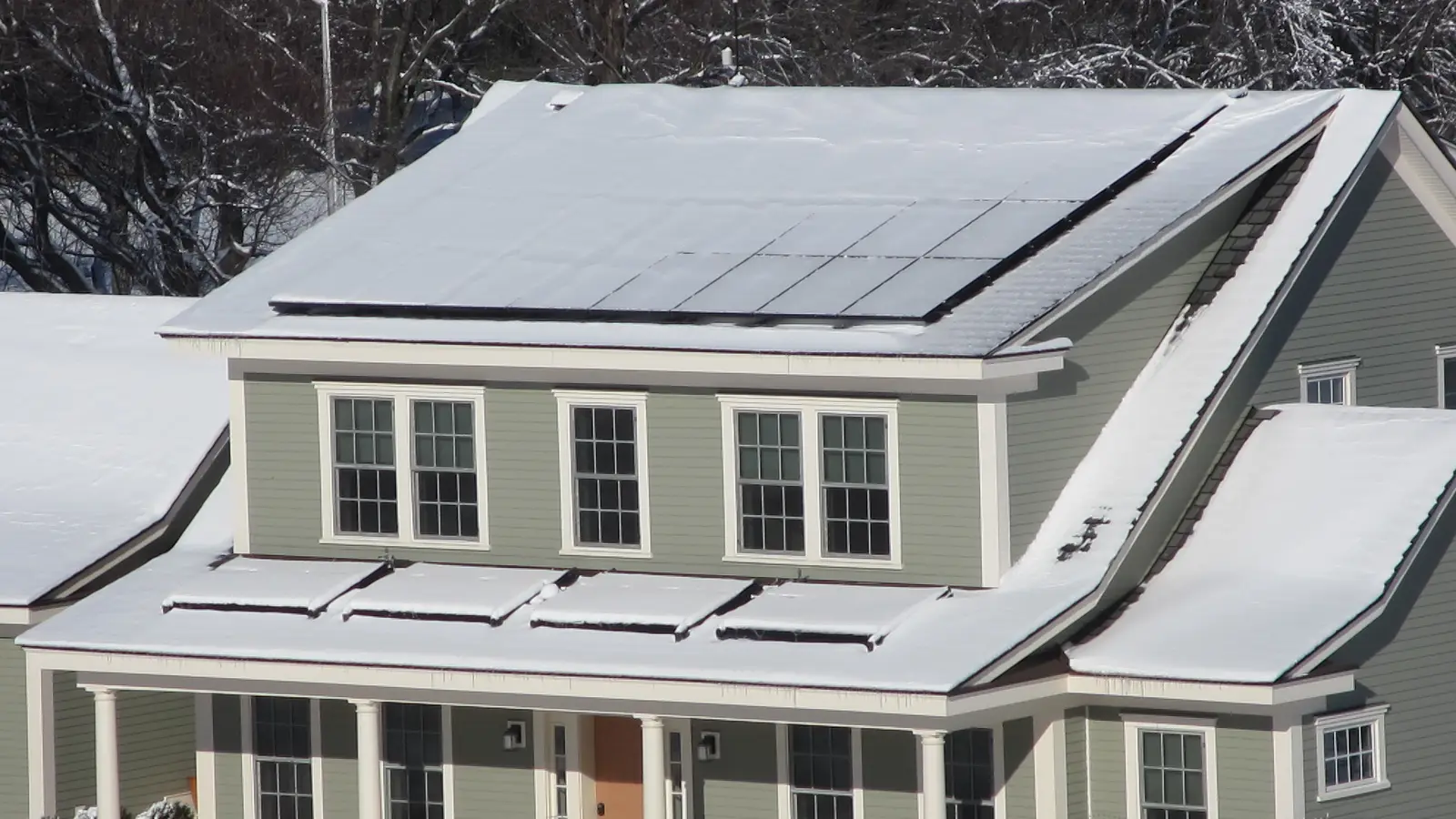
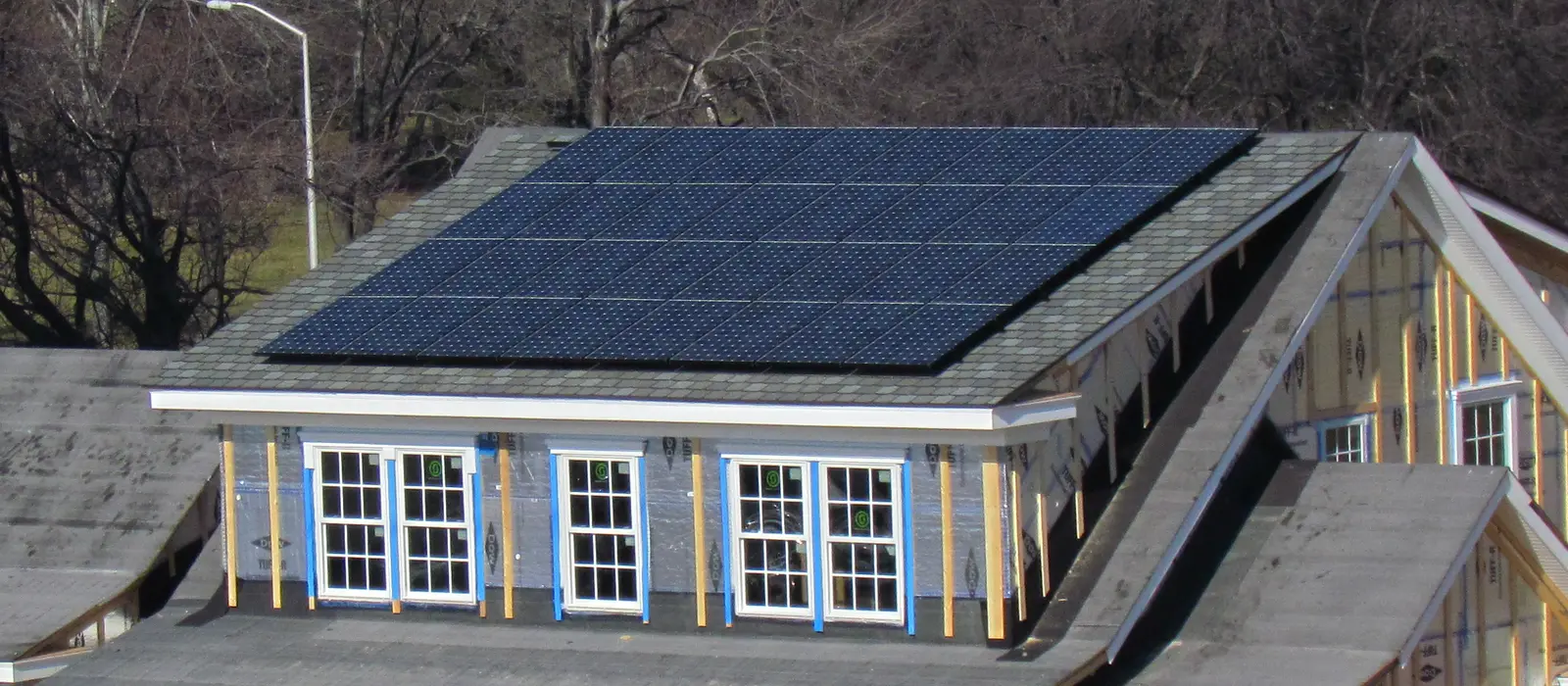
The table above is before snow days: PVWatts' default 14% loss assigns 0% to snow cover, according to its manual. The photo at the top of this page shows NIST's net-zero test house in Gaithersburg, Maryland, in January 2014. NIST's caption says snow covered its panels on 38 days that winter and the house still produced more energy than it used over the year.
- Do not climb onto a snowy roof or stand on the panels. DOE says removing accumulated snow is not recommended, that shovels can cause damage and that stepping or standing on panels will cause damage.
- If heavy snow is sitting on the panels before another storm, DOE says to clear it gently with a broom or brush, never a shovel. On a pitched roof, leave that to a trained crew.
- After a severe storm, DOE suggests a trained professional check for broken glass, detached frames and warped modules, and confirm the system is producing as expected.
- Panels are typically load-tested and certified under the IEC 61215 standard. DOE says a typical rating is 2,400 pascals and recommends at least 5,000 Pa where heavy snow accumulation is a risk. Ask which rating the quoted panels carry.
How PSEG Long Island carries summer power into winter bills
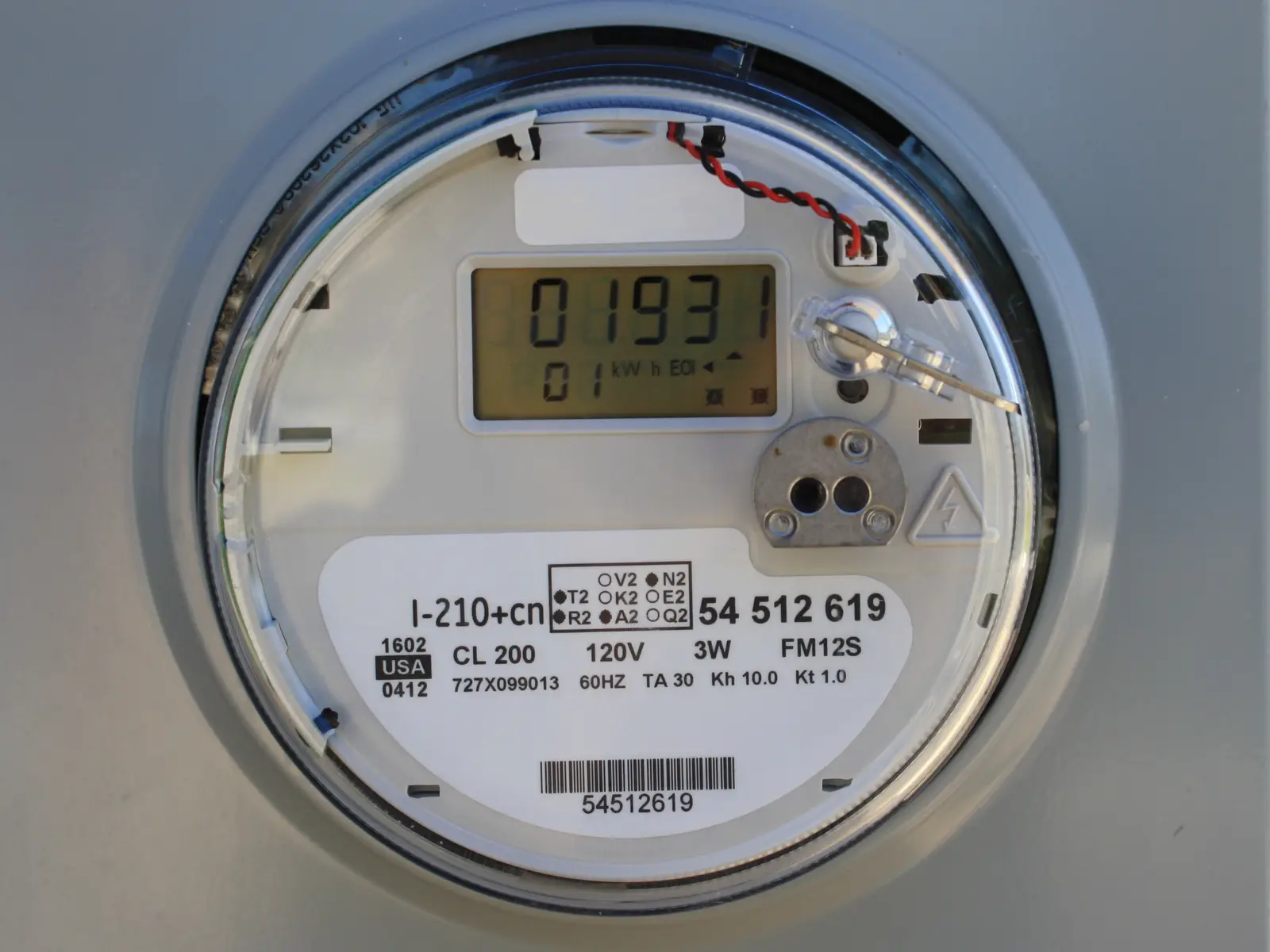
Winter output does not have to match winter use month by month. PSEG Long Island net-meters solar homes: in a month when the panels send more power to the grid than the house draws, each extra kilowatt-hour earns one energy credit in your Energy Credit Bank, and credits come back out automatically in months when you use more than you make.
PSEG's own bill example shows the winter side of that: a month that used 212 kWh more than the system made took all 212 from the bank, leaving 447 of 659 credits, and billed 0 kWh. You still get a bill every month, because it carries a daily service charge for your connection to the grid.
- Systems installed after January 1, 2018: credits roll forward month to month through the year, with no annual reset. PSEG's brochure says that, as of 2018, this was scheduled to stay in effect for 20 years from when you start net metering, for residential and small commercial (Rate 280) customers.
- Systems installed before January 1, 2018: credits run on a 12-month year that ends on your net meter reconciliation date. Credits left on that date are paid out at the SC-11 buy-back rate, the wholesale cost of power, and the bank resets. PSEG says you get the most value when reconciliation falls in the month with credits in the bank, typically around February, and allows a one-time change of the date.
- PSEG Long Island links this brochure (form FC 15014, printed 9/18) from its current Net Meter Bank Exchange page, read November 5, 2026.
Time-of-Day rates: winter solar fills the off-peak bank
PSEG Long Island's Time-of-Day rate prices weekdays from 3 to 7 p.m. as peak. Nights, weekends and federal holidays are always off-peak. PSEG's Time-of-Day page says it would begin moving residential accounts from the 180 Flat Rate to Time-of-Day in 2024, with some exceptions.
On a Time-of-Day rate (194 or 195), solar credits land in a separate bank for each period. PSEG's brochure says peak and off-peak banks cannot be combined; its current page lets customers who started net metering in 2018 or later request a transfer between banks once per bill cycle, on the Excess Generation Exchange Authorization Form, at least two weeks before the next bill date.
Winter makes the bank question sharper. In the PVWatts hourly run for the south-facing roof, only about 6% of December's output comes between 3 and 7 p.m., against about 27% in July. Nearly everything a Long Island array makes in winter lands in the off-peak bank, so ask whoever models your system to show which bank the credits go into, month by month.
Winter outages: what solar panels do and do not do
A grid-tied system without a battery shuts off when the grid goes down. PSEG Long Island says that if an outage affects your area, you will also lose power unless your solar system includes a battery backup; it is a safety rule for the crews working on the lines.
With a battery, DOE's pre-storm advice is to charge it fully before severe weather arrives. How big a battery to buy, and which circuits it carries, is a separate design question.
What a Long Island solar quote should show you for winter
- Monthly production for each roof plane, with December through February shown, not only an annual total.
- The direction and tilt of every plane in the design. In the PVWatts runs above, a west-facing plane keeps 97% of a south plane's output in July but only 54% in December.
- A shade check at winter sun angles.
- How the array handles snow and ice: the panels' load rating, a landscape or portrait layout, and the ice-dam barrier that DOE's winter guidance calls for on roof-mounted systems.
- Your last 12 months of PSEG Long Island usage set against the monthly production, with the credit bank balance by month and by Time-of-Day period.
- Whether a battery is included, and what it would run in an outage.
FAQs
Do solar panels work in winter on Long Island?
Yes. PVWatts estimates that an 8 kW south-facing array in central Suffolk makes about 616 kWh in December and 649 in January, 53% and 56% of its July output. December through February is about 19% of the year's production.
How much less do solar panels produce in winter?
On a south-facing Long Island roof, December output is about half of July's in PVWatts: 616 against 1,158 kWh for 8 kW. On a west-facing roof it falls to about 30% of July: 333 against 1,126 kWh. Snow days cut it further; PVWatts' default losses include none for snow.
Do solar panels work better in cold weather?
The cells do. The U.S. Department of Energy says PV modules operate more efficiently in colder weather, because temperatures above 77°F cause decreases in voltage. Winter output is lower only because there is less sunlight.
Do solar panels work when they are covered with snow?
Not the covered part. PSEG Long Island notes that you draw power from the grid when snow covers your panels. DOE says most snow melts quickly off solar panels or is blown off by wind, and steeper, landscape-mounted panels shed it faster.
Should I remove snow from my solar panels?
The Department of Energy advises against it: it says removing accumulated snow is not recommended, that shovels can cause damage and that standing on panels will cause damage. If heavy snow must come off before another storm, use a soft broom or brush, and on a pitched roof leave it to a trained crew.
Can solar panels work without direct sun?
They make less on cloudy days and nothing at night. PSEG Long Island's brochure lists nights, cloudy days and snow-covered panels as the times a solar home draws power from the grid, and net metering credits from sunnier months cover those draws.
Why is my electric bill higher in winter if I have solar panels?
In winter the panels make about half their July output, so more of your use comes from the grid or from banked credits. On Time-of-Day rates, credits sit in separate peak and off-peak banks, and every PSEG Long Island bill carries a daily service charge for the grid connection.
Do PSEG Long Island solar credits carry over to winter?
Yes. For systems installed after January 1, 2018, each extra kWh earns one credit that rolls forward month to month with no annual reset. Systems installed before then run on a 12-month year that ends on the net meter reconciliation date, when leftover credits are paid out at the SC-11 buy-back rate.
Will my solar panels keep my power on in a winter outage?
Not without a battery. PSEG Long Island says a solar home loses power in an outage unless its system includes battery backup, a safety rule for line crews. With a battery, DOE advises charging it fully before a storm.
How much snow does Long Island get in a winter?
NOAA's 1991–2020 normals for Long Island MacArthur Airport in Islip give about 31.8 inches in a normal season, with January the snowiest month at 10.3 inches.
About the author
Alex Lubin
Founder, EnergiSense
Alex Lubin founded EnergiSense on Long Island in 2021. EnergiSense plans solar, battery, roofing and home energy projects for Nassau and Suffolk homes. This guide is built from PVWatts runs made on November 5, 2026 for central Suffolk and Hicksville, NOAA's 1991–2020 climate normals for Islip, PSEG Long Island's net metering and Time-of-Day pages and the U.S. Department of Energy's winter guidance for solar systems, all read on November 5, 2026. It quotes no EnergiSense price and promises no production figure for any particular house.
Full founder storyNext best page
Filed under: Solar
Get my quote